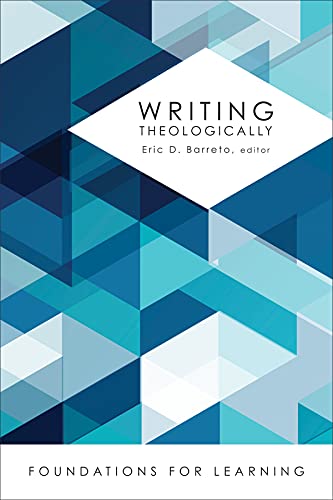
Writing theologically / [manuscript] / edited by Eric D. Barreto.
Material type: TextSeries: Foundations for learning | Foundations for learningPublisher: Minneapolis : Fortress Press, [2015]Description: ix; 157 pages ; 23 cmContent type:
 - text
- unmediated
- volume
- 9781451483406 (pbk.)
- 1451483406 (pbk.)
- 808/.0662 23
- BR44 .W756 2015
| Item type | Current library | Call number | Status | Barcode | |
|---|---|---|---|---|---|
 Books
Books
|
Ethiopian Graduate School of Theology Library Available at Circulation Section | 808.0662 Wri 2015 (Browse shelf(Opens below)) | Available | 17116 |
Includes bibliographical references (pages 149-157)
Introduction / Eric D. Barreto -- Writing basically / Richard Newton -- Writing persuasively / David G. Garber Jr. -- Writing for the ear / Karyn L. Wiseman -- Writing briefly / Shively T.J. Smith -- Writing creatively / Angela Yarber -- Writing publicly / Grace Ji-Sun Kim -- Writing digitally / Adam J. Copeland -- Writing purposefully / Melinda A. McGarrah Sharp -- Writing personally / Raj Nadella -- Writing spiritually / Jacob D. Myers.
Of course, by writing we refer to the kinds of reflections, essays, and exams students will have to complete in the seminary classroom. But writing also encompasses the many modes of communication and self-discovery that creative expression can unlock. Writing Theologically introduces writing not just as an academic exercise but as a way for students to communicate the good news in rapidly changing contexts, as well as to discover and craft their own sense of vocation and identity. Most important will be guiding students to how they might begin to claim and hone a distinctive theological voice that is particularly attuned to the contexts of writer and audience alike. In a collection of brief, readable essays, this volume, edited by Eric D. Barreto, emphasizes the vital skills, practices, and values involved in writing theologically. That is, how might students prepare themselves to communicate effectively and creatively, clearly and beautifully, the insights they gather during their time in seminary? Each contribution includes practical advice about best practices in writing theologically; however, the book also stresses why writing is vital in the self-understanding of the minister, as well as her or his public communication of the good news.
There are no comments on this title.