
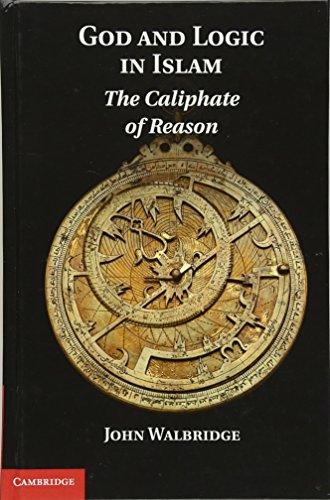
God and logic in Islam : the caliphate of reason / John Walbridge.
Material type: TextPublication details: Cambridge ; New York : Cambridge University Press, c2011.Description: xvi, 211 p. : ill. ; 24 cmISBN:
 - 9780521195348 (pbk)
- 0521195349
- 001.0917 Wal 2011 22
- B745.R4 W35 2011
| Item type | Current library | Call number | Status | Barcode | |
|---|---|---|---|---|---|
 Books
Books
|
Ethiopian Graduate School of Theology Library Available at Circulation Section | 001.0917 Wal 2011 (Browse shelf(Opens below)) | Available | 19019 |
Browsing Ethiopian Graduate School of Theology Library shelves, Shelving location: Available at Circulation Section Close shelf browser (Hides shelf browser)

|

|
|

|

|

|

|
||
| 001.023 Bis 1999 Management consulting : a complete guide to the industry / | 001.0917 Ros 2007 v.2 Knowledge triumphant : the concept of knowledge in medieval Islam / | 001.0917 Ros 2007 v.2 c.2 Knowledge triumphant : the concept of knowledge in medieval Islam / | 001.0917 Wal 2011 God and logic in Islam : the caliphate of reason / | 001.1094 Har 1992 The Harvest of humanism in Central Europe : essays in honor of Lewis W. Spitz / | 001.2 Bai 1969 Erasmus / | 001.209 Kri 1992 Medieval aspects of Renaissance learning : three essays / |
Includes bibliographical references (p. 187-202) and index.
1. Introduction -- Part I. The formation of the Islamic tradition of reason: 1. The problem of reason in Islam: is Islam a non-rational religion and civilization?; 2. The diversity of reason; 3. Empirical knowledge of the mind of God; 4. The failure of the F ar abian synthesis of religion and philosophy; 5. Mysticism, post-classical Islamic philosophy, and the rise and fall of Islamic science -- Part II. Logic, education, and doubt: 6. Where is Islamic logic?: the triumph of scholastic rationalism in Islamic education; 7. The long afternoon of Islamic logic; 8. The institutionalization of disagreement -- Part III. The fall and the future of Islamic rationalism: 9. The decline and fall of scholastic reason in Islam; 10. A chaos of certitudes: the future of Islamic reason.
"This book investigates the central role of reason in Islamic intellectual life. Despite widespread characterization of Islam as a system of belief based only on revelation, John Walbridge argues that rational methods, not fundamentalism, have characterized Islamic law, philosophy and education since the medieval period. His research demonstrates that this medieval Islamic rational tradition was opposed by both modernists and fundamentalists, resulting in a general collapse of traditional Islamic intellectual life and its replacement by more modern but far shallower forms of thought. However, the resources of this Islamic scholarly tradition remain an integral part of the Islamic intellectual tradition and will prove vital to its revival. The future of Islam, Walbridge argues, will be marked by a return to rationalism"--Provided by publisher.
There are no comments on this title.