
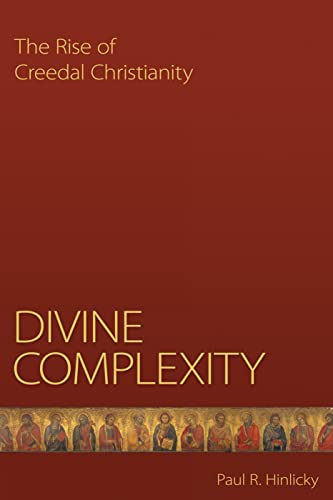
Divine complexity : [manuscript] : the rise of creedal Christianity / Paul R. Hinlicky.
Material type: TextPublication details: Minneapolis, Minn. : Fortress Press, c2011.Description: xii, 284 p. ; 23 cmISBN:
 - 9780800696696 (pbk)
- 0800696697 (alk. paper)
- 231/.044 22
- BT111.3 .H56 2011
| Item type | Current library | Call number | Status | Barcode | |
|---|---|---|---|---|---|
 Books
Books
|
Ethiopian Graduate School of Theology Library Available at Circulation Section | 231.044 Hin 2011 (Browse shelf(Opens below)) | Available | 14884 |
Browsing Ethiopian Graduate School of Theology Library shelves, Shelving location: Available at Circulation Section Close shelf browser (Hides shelf browser)

|

|

|

|

|
|
No cover image available | ||
| 231.044 Gun 1993 The One, the Three, and the many : [manuscript] : God, creation, and the culture of modernity / | 231.044 Gun 2003 Father, Son, and Holy Spirit : essays toward a fully trinitarian theology / | 231.044 Hil 1982 The three-personed God : the Trinity as a mystery of salvation / | 231.044 Hin 2011 Divine complexity : [manuscript] : the rise of creedal Christianity / | 231.044 Jen 1982 The triune identity : God according to the gospel / | 231.044 Jen 1982 c.2 The triune identity : God according to the gospel / | 231.044 Joh 1961 The one and the many in the Israelite conception of God, / [manuscript] / |
Includes bibliographical references (p. 241-275) and index.
The primacy of the gospel -- From resurrection kerygma to gospel narrative -- The scriptures' emergence as the church's canon -- The trinitarian rule of faith -- The confrontation of biblical and philosophical monotheism -- The holy Trinity as the eternal life -- Postscript: The "impassible passibility" of the Trinity.
"Paul Hinlicky reads the history of the early church as a genuine, centuriesilong theological struggle to make sense of the confession of Jesus' life, death, and resurrection. Protesting a recent parting of the ways between systematic theology and the history of early Christianity, Hinlicky relies on the insights of historical criticism to argue in this historical survey for the coherence of doctrinal development in the early church. Hinlicky contends that the Christian tradition shows evidence of being governed by a hermeneutic of 'cross and resurrection.' In successive chapters he finds in the New Testament writings a collective Christological decision against docetism; in the union of Old and New Testaments, a monotheistic decision against Gnostic dualism; in the resulting sweep of the canon a narrative of the divine economy of salvation that posed a trinitarian alternative to Arian Unitarianism; and in the insistence upon the cross of the incarnate Son, a rebuke of Nestorianism" -- Publisher description.
There are no comments on this title.